Local Cluster
Every star within about ten light years of Earth, rebuilt as one playable system.
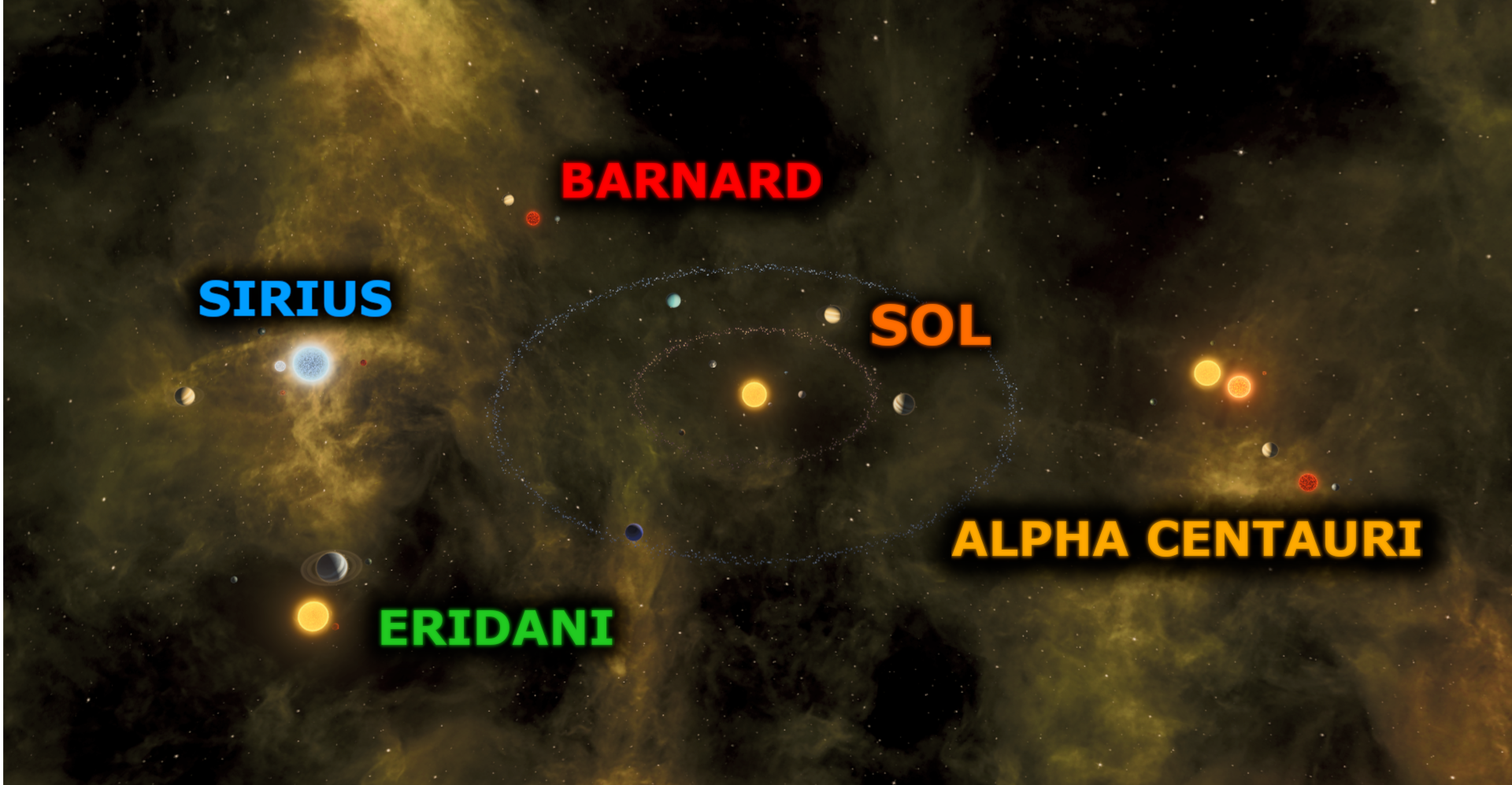
Sol, Alpha Centauri, Proxima Centauri, Barnard's Star, Sirius and Epsilon Eridani are normally scattered across the galaxy map as separate stars you might never even visit. Local Cluster folds all six into a single eight-star system, with their real planets orbiting where they belong.
You start on Earth. Everything humanity has ever pointed a telescope at is now one system away.
This does NOT replace vanilla Sol
Local Cluster is a separate, self-contained system. It adds a new home system and leaves the base game completely alone.
- Vanilla Sol still exists and still generates exactly as it always has
- No vanilla files are overwritten, replaced or patched
- Sol-based mods, Earth origins and rescripted human empires are unaffected
- Nothing is removed from the galaxy
If you want ordinary Sol, it is still right there. This is an alternative, not a replacement.
The system
Eight stars, arranged as they actually sit in our neighbourhood.
Sol - G-type
Mercury, Venus, Earth, Mars, the asteroid belt, Jupiter, Saturn, Uranus, Neptune, and the Kuiper belt out past the edge. Earth is your home world. Mars and Venus are both terraforming candidates.
Alpha Centauri - Rigil Kentaurus (G) and Toliman (K), a close binary pair
Brimstone, a molten world. Noxaris, a toxic world worth terraforming. And Terra Nova, a tropical world waiting for you.
Proxima Centauri - M-type red dwarf, orbiting the Alpha Centauri pair
Silica, a frozen barren world open to terraforming, and the gas giant Jotun.
Barnard's Star - M-type red dwarf
Obsidia, another terraforming prospect, and the gas giant Taranos.
Sirius - The Dog Star (A) and The Pup (F), the brightest thing in your night sky
The molten worlds Kelvon and Vulcira, the gas giant Hyperion, and Arcadia, an ocean world.
Epsilon Eridani - K-type orange dwarf
Fervion, the ringed gas giant Polyphemus, and the frozen world Madison. Polyphemus holds a moon called Eden - a full Gaia world.
Guaranteed habitable worlds
Terra Nova, Arcadia and Eden are placed as proper guaranteed habitables, so the cluster stays viable as a start rather than being scenery you cannot use. How many you actually get still follows your galaxy setup slider, exactly like vanilla.
The neighbourhood
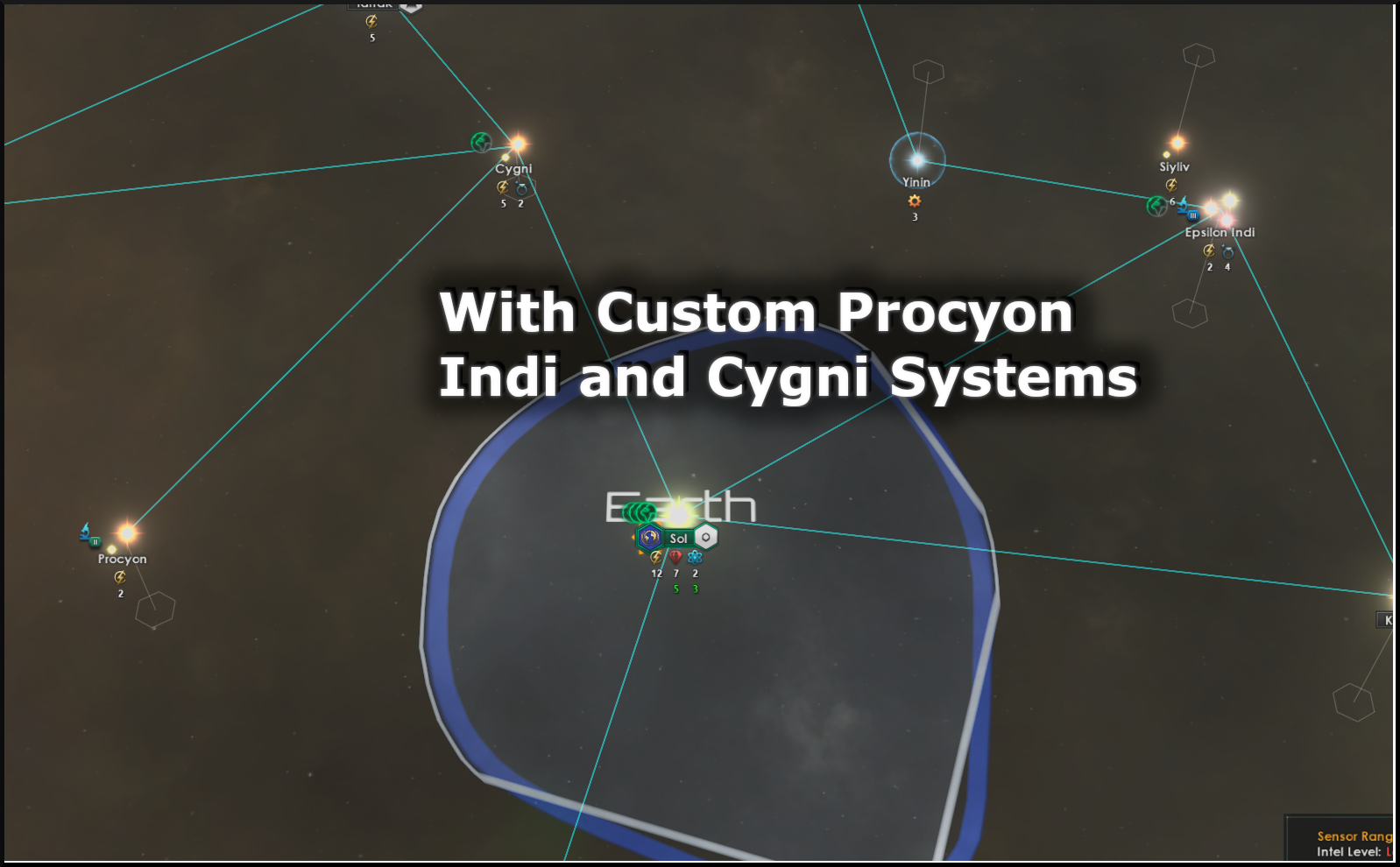
The surrounding stars are handbuilt too, and which ones appear depends on your guaranteed habitable worlds setting:
- 61 Cygni - a K-type binary with a tidally locked habitable world, a crystal asteroid field and a ringed gas giant. Always present.
- Procyon - an F-type binary with a rocky asteroid belt.
- Epsilon Indi - a trinary system. A K-type primary, plus two brown dwarfs orbiting each other around a shared barycenter, and a relic world.
- Tau Ceti - a quiet G-type system with a Gaia world.
Compatibility
Built for Stellaris 4.4.
Because the mod only adds new content and never overrides base game files, it should sit comfortably alongside almost anything. It does not touch Sol, does not modify galaxy generation, and does not alter any vanilla system.
Achievement compatible - it is a system definition, not a rules change.
Notes
The three subsystems each hang off an invisible anchor point so their stars orbit as real pairs and trios rather than sitting in a flat line. These anchors delete themselves the moment the game starts and never appear to the player.
The whole cluster is scaled to fit inside one system view, so orbital distances are compressed for playability rather than being true to scale. Everything is where it should be relative to everything else.
| Title | Local Cluster |
|---|---|
| Steam ID | 3634498401 |
| Steam App | 281990 (steamDB) |
| Steam Manifest/UGC | 343145927837266205 |
| Creator SteamID | 76561199681994209 |
| Steam Created | 2025-12-29T18:37:42+00:00 |
| Steam Updated | 2026-07-30T20:44:48+00:00 |
| Steam Updated relative | 74.2 days ago |
| Revision # | 9 |
| Revision archived? | NO! |
| Revision file date | |
| Tracked Steam files | 4 |
| Tracked mod files | 0 |
| Mod size | 220.55 KB |
Tracked mod revisions
| Title | Revision # | Archived? | Size | Metadata created | Metadata last updated |
|---|---|---|---|---|---|
| Local Cluster | 9 | NO | 220.55 KB | 2026-10-10 13:46:39 | 2026-10-10 23:05:01 |
| Local Cluster | 8 | NO | 217.66 KB | 2026-10-10 13:32:34 | 2026-07-30 20:05:01 |
| Local Cluster | 7 | NO | 214.83 KB | 2026-10-10 11:51:20 | 2026-07-20 05:05:01 |
| Local Cluster | 6 | NO | 214.83 KB | 2026-10-10 11:10:42 | 2026-05-01 03:05:02 |
| The Local Cluster - Alternative To Sol System [RSA] | 5 | NO | 208.14 KB | 2026-10-10 09:19:28 | 2026-03-29 16:05:02 |
Mod File inventory
| Path | Extension | File Count | File Size |
|---|