If you are interested in even more depth and diversity, check out my new mod that expands upon the concepts I have introduced here: mod_detail.php?publishedfileid=2631414131.
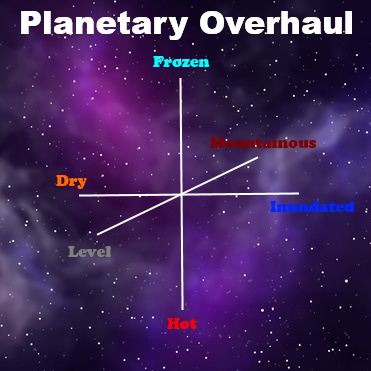
An overhaul of planetary deposit spawning, habitability and planet types, based on Gatekeeper's Planetary Diversity. The number of planet types has been cut down to 27, several planet definitions tweaked, and then they have been arranged in a cube, based on three axes:
[olist]
Terrain: Mountainous - Varied - Level
Earth would be considered Varied, while a Mountainous planet has far more mountainous terrain than level terrain, and a Level planet has very few mountains, if any.
Average Temperature: Hot - Temperate - Frozen
While this describes the average temperature, some planets experience hot summers and cold winters. These have a more specific seasonal temperature climate.
Hydrosphere: Dry - Wet - Inundated
An Inundated planet that is Varied or Mountainous are all 85%+ covered in oceans, while the Level Inundated planets are just very wet planets with mostly water-saturated ground. Some planets experience more Seasonal hydrospheres, with dry summers and wet winters.
[/olist]
Arid Dry frozen climate with level terrain and no seas.
Antarctic Dry frozen climate with varied terrain and no seas.
Frigid Dry frozen climate with mountainous terrain and no seas.
Tundra Seasonally wet and frozen climate with level terrain and small seas.
Boreal Seasonally wet and frozen climate with varied terrain and small seas.
Alpine Wet frozen climate with mountainous terrain and small seas.
Snow Very wet frozen climate with level inundated terrain.
Arctic Dry frozen climate with varied terrain and a vast frozen ocean.
Glacial Dry frozen climate with mountainous terrain and a vast ocean.
Steppe Dry seasonally cool climate with level terrain and no seas.
Mediterranean Dry seasonally warm climate with varied terrain and small seas.
Atacama Extremely dry cold mountains and temperate wet valleys with no seas.
Prairie Seasonal temperate climate with level terrain and small seas.
Continental Wet seasonal climate with varied terrain and oceans.
Cascadian Wet seasonal climate with mountainous terrain and oceans.
Bog Wet temperate climate with level inundated terrain.
Ocean Wet temperate climate with varied terrain and a vast ocean.
Crag Dry temperate climate with mountainous terrain and a vast ocean.
Dune Hot dry climate with level terrain and no seas.
Desert Hot dry climate with varied terrain and no seas.
Mesa Hot dry climate with mountainous terrain and no seas.
Oasis Hot seasonal climate with level terrain and a large sea.
Savannah Hot seasonal climate with varied terrain and small seas.
Tropical Hot wet climate with mountainous terrain and oceans.
Mangrove Hot wet climate with inundated terrain and large seas.
Atoll Hot dry climate with varied terrain and a vast ocean.
Tepui Hot wet climate with mountainous terrain and a vast ocean.
There is about a 10% chance that a Bog planet will be a Mycelium planet instead, but it has the same habitability as a Bog planet. Retinal planets were changed to a Planet Modifier which can spawn on any habitable world, giving -10% habitability, but +10% immigration. All other regular planets form Planetary Diversity were removed, though all rare and exotics have not been touched.
Same planet type: 80%, other than the "corners" (Arid, Frigid, Snow, Glacial, Dune, Mesa, Mangrove, Tropical) get 90%. From this, reduce habitability by:
~10% per Terrain difference
~20% per Hydrosphere difference
~30% per Temperature difference
With this, most planet types have three total types that are 70%+ habitability at the beginning of the game, ~5 that are 60%+, ~12 that are 40%+, and ~20 that are 20%+.
The amount of basic district types are much more dependent on a planet's characteristics.
Mining district deposits are much more likely to spawn on Mountainous planets, slightly more likely on Dry, slightly less likely on Inundated, and much less likely on Level planets. So, Frigid, Atacama, and Mesa planets will tend to have the most mineral deposits, while Snow, Bog, and Mangrove will have the least.
Agriculture district deposits are much more likely to spawn on Wet hydrosphere or Temperate planets, slightly more likely on Level, slightly less likely on Mountainous, and much less likely on Dry hydrosphere or Frozen planets. Prairie will most likely have the most, followed closely by Continental, while Frigid will probably have the least, followed closely by Antarctic.
Energy district deposits are much more likely to spawn on Hot planets, slightly more likely on Level, slightly less likely on Mountainous, and much less likely on Frozen. Dune, Oasis, and Mangrove will tend to have the most, while Frigid, Alpine, and Arctic will tend to have the least.
These changes are also reflected in your home planet, so home planets won't all be the exact same as they are in vanilla.
Terraforming is split into three different techs. The first terraforming technology will now be Atmospheric Manipulation, which will let you change the temperature classification of a planet. This will lead to Biosphere Engineering, which allows you to change the hydrosphere classification, and Terrestrial Sculpting, which allows you to change the terrain of a planet.
Changing the temperature will be the fastest and cheapest, but have the largest effect, since temperature changes are a difference of 30% habitability. Changing the terrain will be the longest and most expensive, but have the smallest effect, since terrain changes are only a 10% difference of habitability. As such, you'll have to decide if you are willing to do a quick, cheap terraform that will make the planet "good enough", or a longer more expensive terraform that will make it very good.
Currently, deposit swaps are the same as vanilla, so terraforming will not change the number of available districts.
Planetary Diversity's decision to change the Guaranteed Habitable Planets to same class instead of exact matches will guarantee the planets are types with 60%+ habitability.
Planetary Diversity is required.
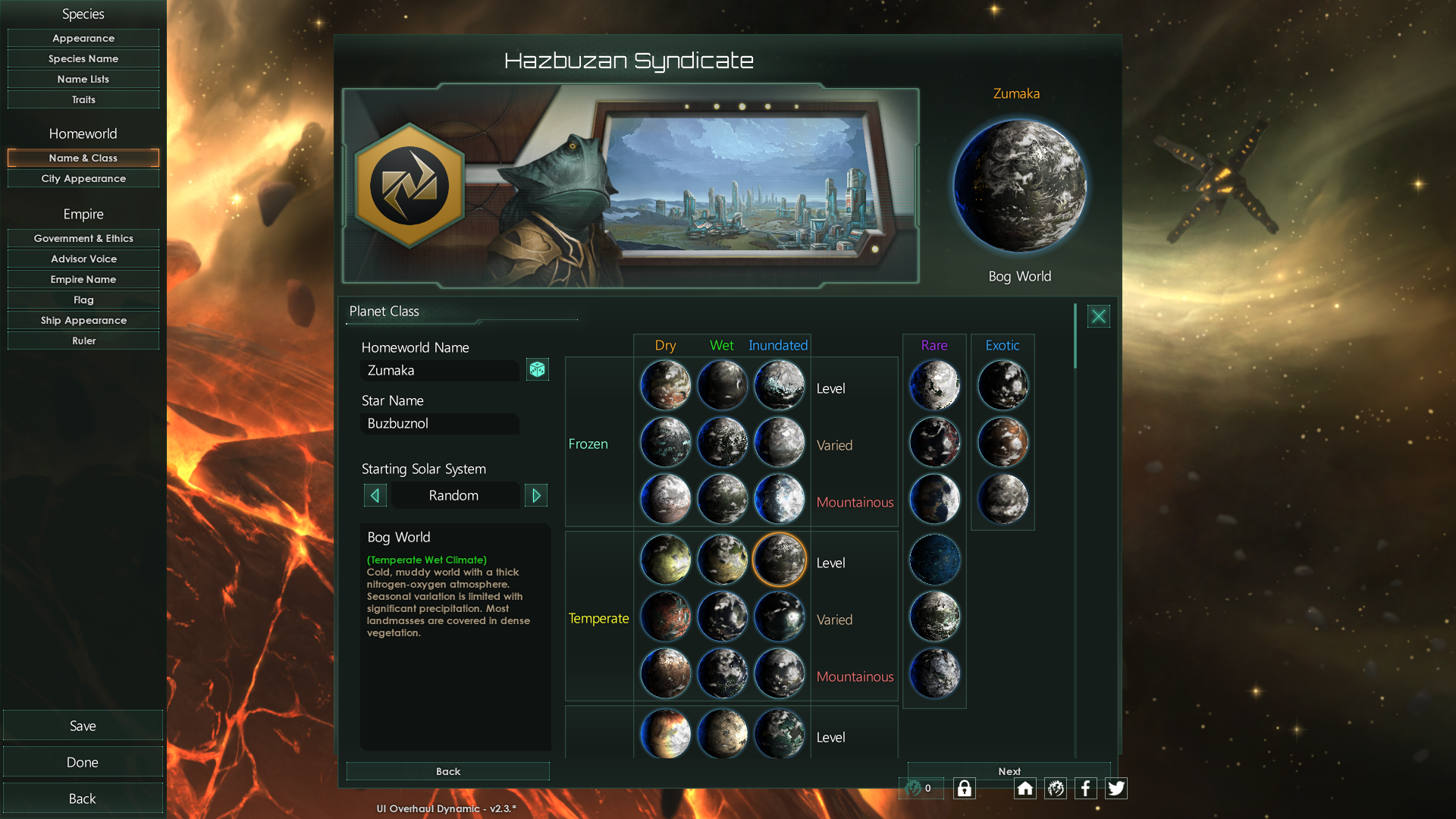
UI Overhaul Dynamic is strongly recommended, as the planet selection screen during empire creation won't look correct without it. The Planetary Diversity patch is required with this.
Guilli's Planet Modifiers is recommended, as his modifiers help to further specialize planets. Compatibility for GPM is built-in to Planetary Overhaul.
**PLANETARY OVERHAUL SHOULD BE BELOW ALL THE REQUIRED MODS IN THE LOAD ORDER IN THE NEW LAUNCHER**

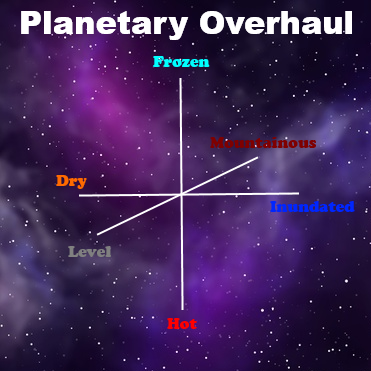
An overhaul of planetary deposit spawning, habitability and planet types, based on Gatekeeper's Planetary Diversity. The number of planet types has been cut down to 27, several planet definitions tweaked, and then they have been arranged in a cube, based on three axes:
[olist]
[/olist]
Planet Types
Arid Dry frozen climate with level terrain and no seas.
Antarctic Dry frozen climate with varied terrain and no seas.
Frigid Dry frozen climate with mountainous terrain and no seas.
Tundra Seasonally wet and frozen climate with level terrain and small seas.
Boreal Seasonally wet and frozen climate with varied terrain and small seas.
Alpine Wet frozen climate with mountainous terrain and small seas.
Snow Very wet frozen climate with level inundated terrain.
Arctic Dry frozen climate with varied terrain and a vast frozen ocean.
Glacial Dry frozen climate with mountainous terrain and a vast ocean.
Steppe Dry seasonally cool climate with level terrain and no seas.
Mediterranean Dry seasonally warm climate with varied terrain and small seas.
Atacama Extremely dry cold mountains and temperate wet valleys with no seas.
Prairie Seasonal temperate climate with level terrain and small seas.
Continental Wet seasonal climate with varied terrain and oceans.
Cascadian Wet seasonal climate with mountainous terrain and oceans.
Bog Wet temperate climate with level inundated terrain.
Ocean Wet temperate climate with varied terrain and a vast ocean.
Crag Dry temperate climate with mountainous terrain and a vast ocean.
Dune Hot dry climate with level terrain and no seas.
Desert Hot dry climate with varied terrain and no seas.
Mesa Hot dry climate with mountainous terrain and no seas.
Oasis Hot seasonal climate with level terrain and a large sea.
Savannah Hot seasonal climate with varied terrain and small seas.
Tropical Hot wet climate with mountainous terrain and oceans.
Mangrove Hot wet climate with inundated terrain and large seas.
Atoll Hot dry climate with varied terrain and a vast ocean.
Tepui Hot wet climate with mountainous terrain and a vast ocean.
There is about a 10% chance that a Bog planet will be a Mycelium planet instead, but it has the same habitability as a Bog planet. Retinal planets were changed to a Planet Modifier which can spawn on any habitable world, giving -10% habitability, but +10% immigration. All other regular planets form Planetary Diversity were removed, though all rare and exotics have not been touched.
Habitability
Same planet type: 80%, other than the "corners" (Arid, Frigid, Snow, Glacial, Dune, Mesa, Mangrove, Tropical) get 90%. From this, reduce habitability by:
~10% per Terrain difference
~20% per Hydrosphere difference
~30% per Temperature difference
With this, most planet types have three total types that are 70%+ habitability at the beginning of the game, ~5 that are 60%+, ~12 that are 40%+, and ~20 that are 20%+.
Resources
The amount of basic district types are much more dependent on a planet's characteristics.
Mining district deposits are much more likely to spawn on Mountainous planets, slightly more likely on Dry, slightly less likely on Inundated, and much less likely on Level planets. So, Frigid, Atacama, and Mesa planets will tend to have the most mineral deposits, while Snow, Bog, and Mangrove will have the least.
Agriculture district deposits are much more likely to spawn on Wet hydrosphere or Temperate planets, slightly more likely on Level, slightly less likely on Mountainous, and much less likely on Dry hydrosphere or Frozen planets. Prairie will most likely have the most, followed closely by Continental, while Frigid will probably have the least, followed closely by Antarctic.
Energy district deposits are much more likely to spawn on Hot planets, slightly more likely on Level, slightly less likely on Mountainous, and much less likely on Frozen. Dune, Oasis, and Mangrove will tend to have the most, while Frigid, Alpine, and Arctic will tend to have the least.
These changes are also reflected in your home planet, so home planets won't all be the exact same as they are in vanilla.
Terraforming
Terraforming is split into three different techs. The first terraforming technology will now be Atmospheric Manipulation, which will let you change the temperature classification of a planet. This will lead to Biosphere Engineering, which allows you to change the hydrosphere classification, and Terrestrial Sculpting, which allows you to change the terrain of a planet.
Changing the temperature will be the fastest and cheapest, but have the largest effect, since temperature changes are a difference of 30% habitability. Changing the terrain will be the longest and most expensive, but have the smallest effect, since terrain changes are only a 10% difference of habitability. As such, you'll have to decide if you are willing to do a quick, cheap terraform that will make the planet "good enough", or a longer more expensive terraform that will make it very good.
Currently, deposit swaps are the same as vanilla, so terraforming will not change the number of available districts.
Guaranteed Habitable Planets
Planetary Diversity's decision to change the Guaranteed Habitable Planets to same class instead of exact matches will guarantee the planets are types with 60%+ habitability.
Required and Recommended Mods
Planetary Diversity is required.
UI Overhaul Dynamic is strongly recommended, as the planet selection screen during empire creation won't look correct without it. The Planetary Diversity patch is required with this.
Guilli's Planet Modifiers is recommended, as his modifiers help to further specialize planets. Compatibility for GPM is built-in to Planetary Overhaul.
**PLANETARY OVERHAUL SHOULD BE BELOW ALL THE REQUIRED MODS IN THE LOAD ORDER IN THE NEW LAUNCHER**
| Title | Relytor's Planetary Overhaul 3.2.* |
|---|---|
| Steam ID | 1837977677 |
| Steam App | 281990 (steamDB) |
| Steam Manifest/UGC | 9142238259360421689 |
| Creator SteamID | 76561197996197114 |
| Steam Created | 2019-08-18T00:03:39+00:00 |
| Steam Updated | 2021-11-29T19:58:48+00:00 |
| Steam Updated relative | 1778.3 days ago |
| Revision # | 46 |
| Revision archived? | Yes (fetch: 2022-04-14 09:58:05) |
| Revision file date | 2021-11-29 19:58:47 |
| Tracked Steam files | 4 |
| Tracked mod files | 102 |
| Mod size | 5.55 MB |
Tracked mod revisions
| Title | Revision # | Archived? | Size | Metadata created | Metadata last updated |
|---|---|---|---|---|---|
| Relytor's Planetary Overhaul 3.2.* | 46 | Yes (fetch: 2022-04-14 09:58:05) | 5.55 MB | 2022-04-10 02:57:03 | 2023-02-07 19:05:01 |
Mod File inventory
| Path | Extension | File Count | File Size |
|---|---|---|---|
| common/deposits | txt | 2 | 99.47 KB |
| common/districts | txt | 1 | 17.48 KB |
| common/on_actions | txt | 2 | 3.19 KB |
| common/planet_classes | txt | 2 | 63.46 KB |
| common/scripted_effects | txt | 1 | 64.49 KB |
| common/scripted_triggers | txt | 1 | 11.26 KB |
| common/scripted_variables | txt | 1 | 1.59 KB |
| common/static_modifiers | txt | 1 | 197 B |
| common/technology | txt | 1 | 4.23 KB |
| common/terraform | txt | 28 | 380.77 KB |
| common/traits | txt | 2 | 120.98 KB |
| events | txt | 2 | 21.96 KB |
| gfx/interface/icons/technologies | dds | 1 | 8.05 KB |
| interface | gui | 1 | 33.82 KB |
| localisation/replace | yml | 1 | 7.11 KB |
| planetary_overhaul/common/deposits | txt | 2 | 99.47 KB |
| planetary_overhaul/common/on_actions | txt | 2 | 3.19 KB |
| planetary_overhaul/common/planet_classes | txt | 2 | 63.46 KB |
| planetary_overhaul/common/scripted_effects | txt | 1 | 64.35 KB |
| planetary_overhaul/common/scripted_triggers | txt | 1 | 10.84 KB |
| planetary_overhaul/common/scripted_variables | txt | 1 | 1.59 KB |
| planetary_overhaul/common/static_modifiers | txt | 1 | 197 B |
| planetary_overhaul/common/technology | txt | 1 | 4.23 KB |
| planetary_overhaul/common/terraform | txt | 28 | 380.77 KB |
| planetary_overhaul/common/traits | txt | 2 | 120.98 KB |
| planetary_overhaul | txt | 1 | 6.95 KB |
| planetary_overhaul | mod | 1 | 181 B |
| planetary_overhaul | png | 2 | 1.96 MB |
| planetary_overhaul/events | txt | 2 | 21.96 KB |
| planetary_overhaul/gfx/interface/icons/technologies | dds | 1 | 8.05 KB |
| planetary_overhaul/interface | gui | 1 | 33.82 KB |
| planetary_overhaul/localisation/replace | yml | 1 | 6.52 KB |